

Agentic AI Weekly | Berkeley RDI | January 7, 2026
AgentBeats Phase 1 Submissions, OpenEnv Custom Track, and Prize / Sponsor Updates; Agentic AI Summit 2026; Trends This Week


AgentX–AgentBeats Highlights: Phase 1 Submissions, OpenEnv Custom Track, Major Prize Updates, and New Sponsors
Happy New Year — and here’s to a 2026 filled with bold ideas, meaningful progress, and innovation ahead!
To kick off the year, a friendly reminder that the AgentX-AgentBeats Phase 1 (Green Agent) submission deadline is approaching soon — make sure to submit your projects by January 15, 2026 at 11:59 PM PT! You can access the AgentBeats Developer Platform (agentbeats.dev) and Phase 1 Submission Form below, along with a step-by-step video walkthrough of the platform. Full tutorial docs and tutorial video are available at agentbeats.dev as well. We look forward to reviewing your work and seeing the incredible ideas you’ve been building!
Additionally, we’re thrilled to announce a new AgentBeats custom track: the OpenEnv Challenge: SOTA Environments to Drive General Intelligence, sponsored by the PyTorch team at Meta, Hugging Face, and Unsloth. Participants will compete to develop innovative, open-source RL environments that push the frontiers of agent learning, with a prize pool of $10K in Hugging Face credits, and the chance to be published on the PyTorch blog.
We’re also pleased to share a major update to our prize offerings: OpenAI will provide $10,000, $5,000, and $1,000 in credits to the 1st, 2nd, and 3rd place teams in each of the two competition tracks — the Research Agent Track and the Finance Agent Track. Best of luck to everyone competing!
Last month, Google DeepMind, Nebius, Lambda, and Sierra hosted a series of virtual workshops and info session, featuring live demos of Gemini, Google AI Studio, and Nebius Token Factory, and deep-dives into Lambda’s Agent Security Custom Track and Sierra’s dedicated τ²-Bench Track. Missed one of the sessions? We’ve got you covered! Catch any and all of the recordings below:
As of today, 1300+ teams from around the world have joined AgentX-AgentBeats. So if you haven’t registered yet, now’s the time — don’t miss the chance to participate in this incredible opportunity, where over $1 million in prizes, cloud credits, and API resources are on the line.
Hosted by Berkeley RDI, this global challenge builds on the Agentic AI MOOC community of ~40K learners, uniting builders, researchers, engineers, and AI enthusiasts worldwide to build, benchmark, and push the boundaries of agentic AI.
In this two-phase competition, participants will: First build or enhance benchmarks for agentic AI (Phase 1), and then develop AI agents that excel on them (Phase 2). Together, these phases aim to advance the field by creating high-quality, broad-coverage, and realistic agent evaluations as shared public goods—building a unified, community-driven ecosystem for agent evaluation benchmarks that are compatible, standardized, reproducible, collaborative, and discoverable.
✅ Sign Up for the Competition:
Participant Sign‑Up Form – Each participant must register individually.
Team Sign‑Up Form – After completing your individual registration, please submit a team registration form. All participants must complete this step — even if competing solo (a team may consist of just one participant).
Have questions, want to learn more, or need additional guidance? Watch our insightful AgentX-AgentBeats Info Session, with Berkeley RDI Co-Director Professor Dawn Song and Berkeley RDI Research Fellow Xiaoyuan Liu:
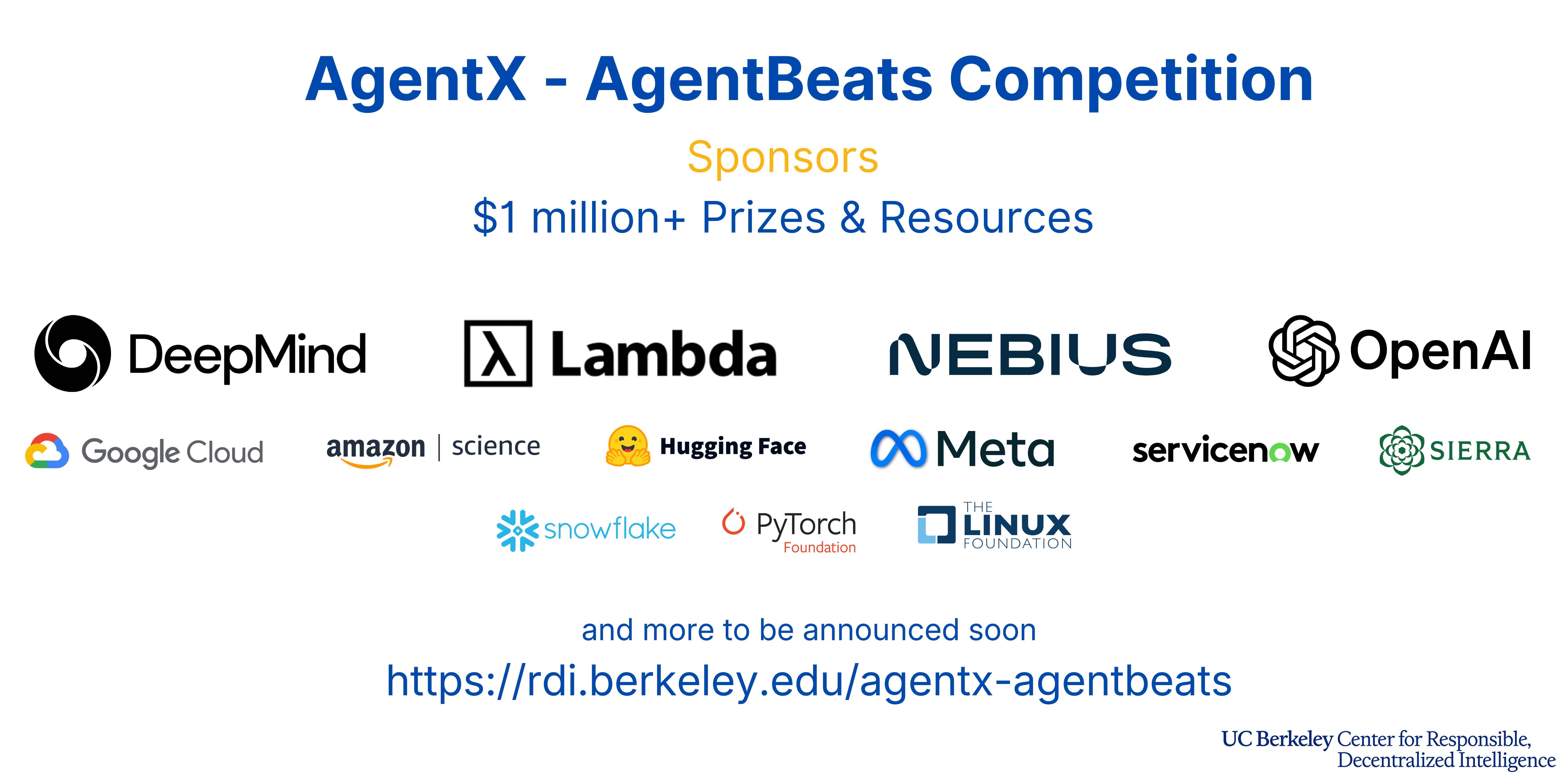
Last but not least, we’re very excited to welcome OpenAI, Meta, and Hugging Face as our newest sponsors, and are thrilled to have these industry leaders join our growing community. Our sincerest thanks to all of our incredible sponsors:
Good luck to everyone in this final stretch of Phase 1! 🤖

Agentic AI Summit 2026
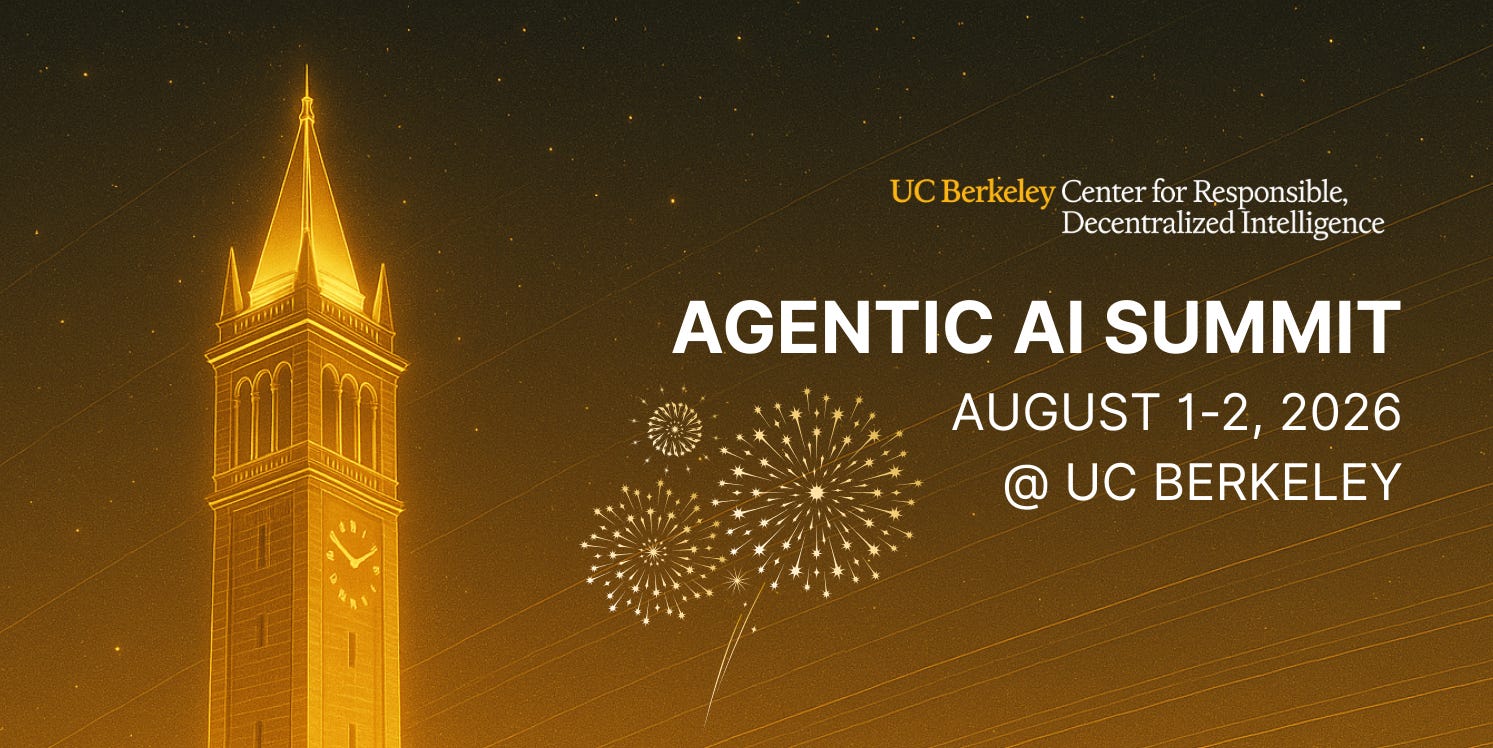
Save the date! The Agentic AI Summit returns to Berkeley on August 1–2, 2026, welcoming 5,000+ expected in-person attendees for two days of insights and innovation. Building on last year’s sold-out success, the summit will unite researchers, builders, industry leaders, and the global agentic AI community for keynotes, technical talks, live demos, hands-on workshops, and more!
Registration details, CFPs, and ways to get involved are coming soon. Join the waitlist to be the first to know — the next chapter of agentic AI starts at Berkeley.

Trends This Week
AI startup Manus is joining Meta as part of a major push into autonomous AI systems. The Manus team and technology will continue operating and serving current customers while accelerating product development and integration into Meta’s broader AI ecosystem. Reported to be worth over $2 billion, the acquisition aims to scale Manus’s AI agents to a much broader global audience.
DeepSeek researchers have proposed Manifold-Constrained Hyper-Connections (mHC), a new architecture that improves on Hyper-Connections (HC) by restoring the identity-mapping property of traditional residual connections while maintaining their performance benefits. By constraining the residual space to a manifold and optimizing system efficiency, mHC reduces instability and memory overhead while delivering consistent performance gains at scale.
OpenAI is making significant strides into audio-first AI, reorganizing engineering and research teams to build advanced voice models and prepare for a new audio-centric personal device expected within about a year. The company’s upcoming audio model aims to deliver more natural, conversational interactions and could power a family of screenless devices that act more like companions than traditional gadgets.
Nvidia has struck a landmark ~$20 billion deal with AI chip startup Groq to license its high-performance inference technology and bring key executives and engineers into Nvidia’s fold — marking the largest AI hardware transaction in the company’s history. The agreement gives Nvidia access to Groq’s ultra-low-latency chip designs and talent while allowing Groq to continue operating independently.
The UK AI Security Institute’s first public analysis of AI systems finds that frontier AI capabilities are advancing rapidly across cyber, bio/chemistry, and autonomy, with performance in some areas doubling every eight months. Models now surpass PhD-level experts in parts of biology and chemistry, can complete expert-level cyber tasks, and autonomously handle hour-long software tasks, while safeguards are improving but still show vulnerabilities. The report also highlights early societal impacts, narrowing gaps between open and closed models, and growing capabilities relevant to autonomy and control risks.
Don’t miss the developments shaping Agentic AI. Subscribe for weekly coverage of groundbreaking research, emerging trends, and critical insights across Agentic AI and the broader AI landscape.

Great weekly roundup. The gap between research demos and practical agents is still about reliability, not capability.
More on building reliable personal AI systems: https://thoughts.jock.pl/p/wiz-personal-ai-agent-claude-code-2026