

Agentic AI Weekly | Berkeley RDI | July 15, 2026
Agentic AI Summit Agenda Now Live and Tickets are Running Out + Livestream Sign-Up | Research Highlight: GPT-5.6's Agents' Last Exam Progress


Research Highlight: GPT-5.6 Release Features Progress on Agents’ Last Exam (ALE)
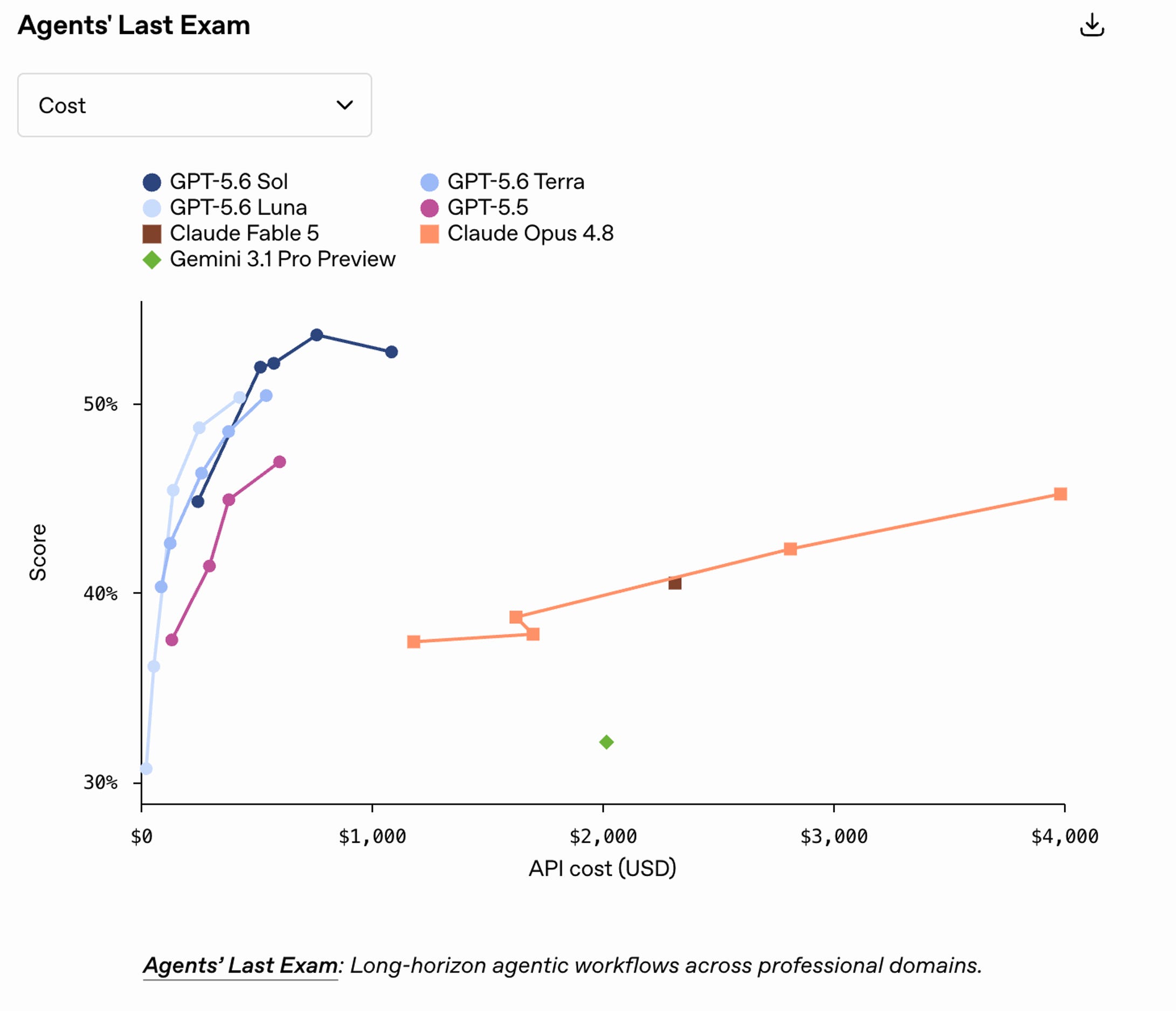
OpenAI’s GPT-5.6 release featured ALE to report professional-agent performance
TL;DR
OpenAI’s July 9, 2026 release of GPT-5.6 highlighted Agents’ Last Exam (ALE) as its primary external evaluation benchmark https://openai.com/index/gpt-5-6/. On ALE’s public leaderboard, Codex powered by GPT-5.6 Sol (XHigh reasoning) achieves an average score of 53.6/100 with a 30.6% full-pass rate on the 152-task ALE-V1 overall split.
ALE provides a realistic and reproducible evaluation of frontier AI agents on economically valuable, long-horizon professional workflows. The full benchmark comprises over 1,500 expert-sourced tasks spanning 55 non-physical occupations, contributed by 300+ domain experts across 100+ institutions.
Looking ahead, ALE will launch Phase 2, expanding the benchmark from 1,500 to 5,000 tasks while substantially deepening coverage across all 55 occupations. Phase 2 is expected to be completed by the end of 2026, with a planned submission to a Nature-family journal in 2027.
Why This Is New / Important
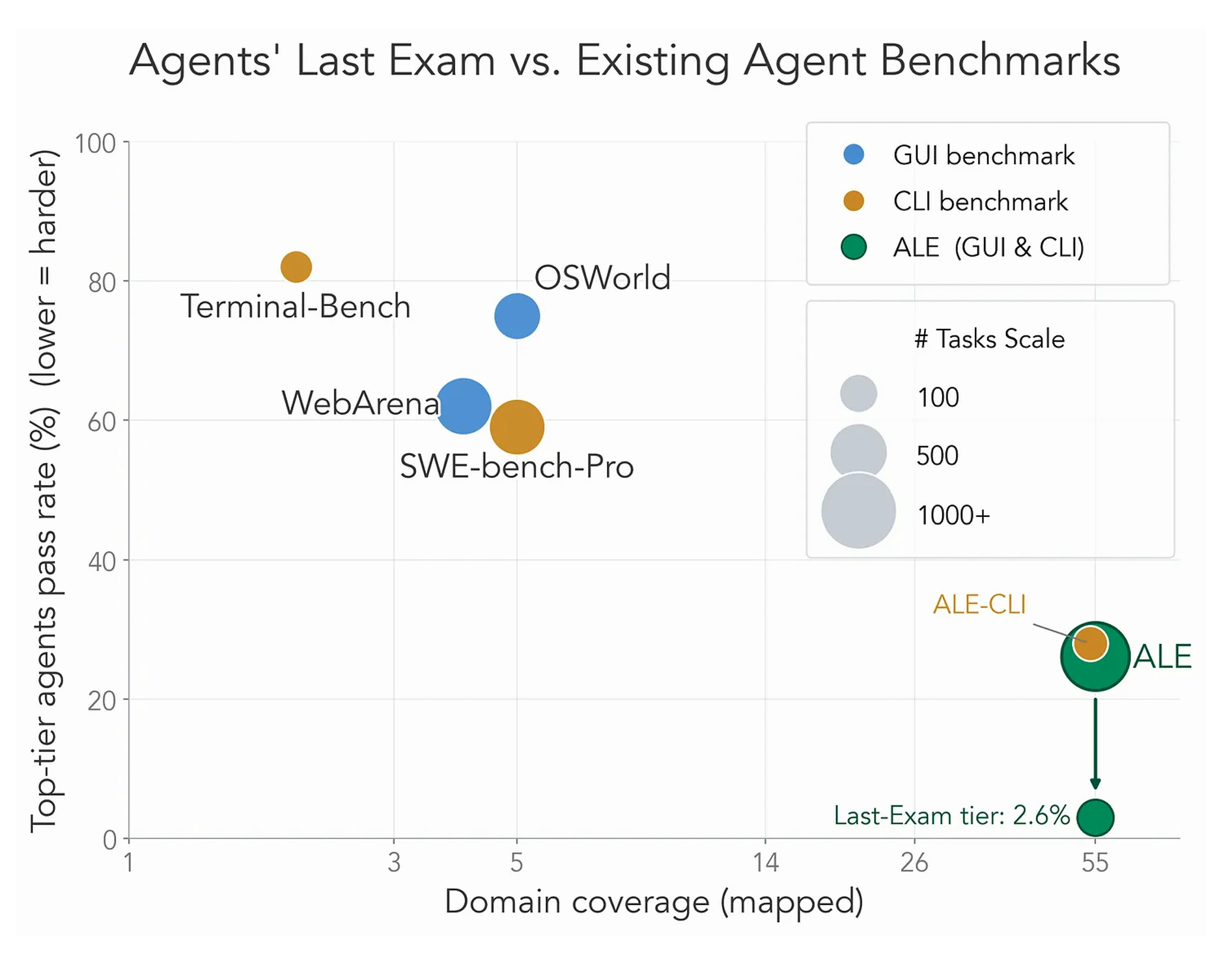
Many of today’s agent benchmarks are rapidly saturating as frontier systems improve. ALE is designed to measure a different capability frontier focused on sustained, economically valuable work, featuring 1,500+ expert-sourced tasks across 55 industry domains with full GUI + CLI environments and outcome-based, verifiable evaluation.
Compared to Terminal-Bench and SWE-bench-Pro, it’s broader (tasks span 40 of ALE’s 55 industry subdomains, vs. 6 and 5), longer-horizon (human time-to-complete ranges from hours to weeks, not minutes or days), and harder (the best agent passes just 25.2%, vs. 82.0% on Terminal-Bench and 59.1% on SWE-bench-Pro).
How It Works
Each ALE task hands an agent a real project that a human expert previously completed, converted into an evaluation with objective, verifiable grading. The agent gets full GUI and CLI access and is free to solve it however a human would: clicking, typing, scripting, browsing. It is judged on the result, not the method. Grading is deterministic and rubric-based, with no human judges: each task’s expert author defines a reference output and rubric.
Industry experts can contribute to ALE (Phase 2) by developing scalable task families, building repeatable task pipelines, or serving as domain leads to guide domain coverage and quality.
Implications
The name “Last Exam” has two meanings. First, “Last” is the bar to clear: passing these exams means an agent can actually do the job and continue to deliver economically valuable work in that profession. Second, “Last” is the frontier of difficulty. The tasks are real, complex, long-horizon, and require professional expertise to execute, meaning ALE sits right at the edge of what today’s agents can reliably accomplish.
To advance this frontier, we welcome contributors to help build our next-iteration benchmark by contributing tasks and referring domain experts (contributors will be invited to join as co-authors). Learn how to contribute at https://agents-last-exam.org/submit, and explore the leaderboard, paper, and demo at https://agents-last-exam.org.

Agentic AI Summit 2026: Tickets are Running Out!
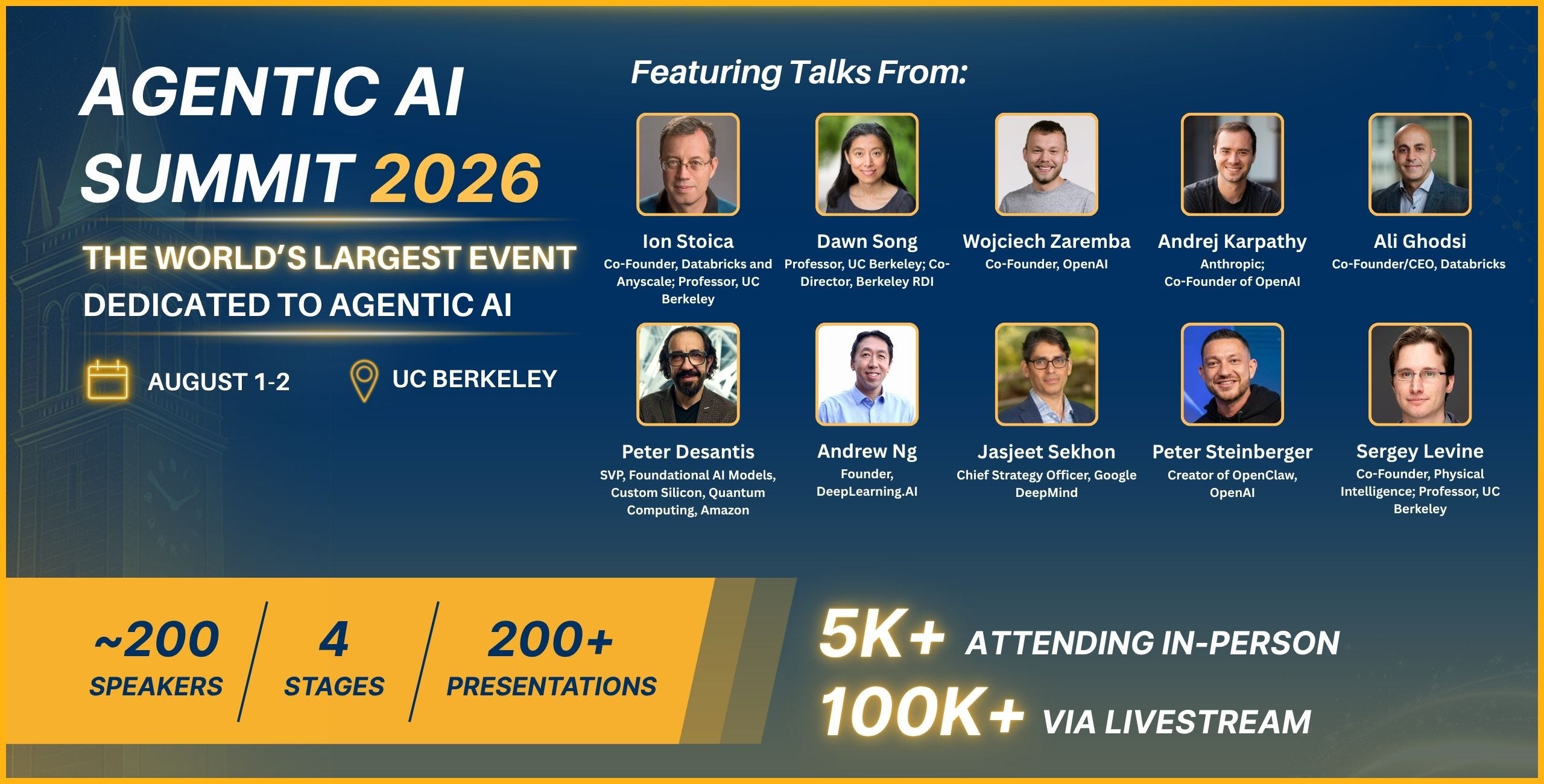
Save the date! The Agentic AI Summit returns to Berkeley on August 1–2, 2026, welcoming 5,000+ expected in-person attendees for two days of insights and innovation. Building on last year’s sold-out success—with 2,000+ in‑person attendees and 40,000+ global livestream participants—the summit will bring together researchers, builders, industry leaders, and the global agentic AI community for keynotes, technical talks and panels, hands-on workshops, live demos, and more!
🎟️ Standard Tickets (Limited Capacity)
Tickets are almost sold out, so now is the time to book your spot!
Standard: $499
Full Summit Agenda Now Available!
We are thrilled to announce that the full agenda for the Summit is now available on our website! The Summit is set to feature 200+ speakers across 4 stages, plus 200+ poster presentations during the event! If you’ve been waiting for the schedule to come out before grabbing your tickets, now is the time to take a look and secure your spot!
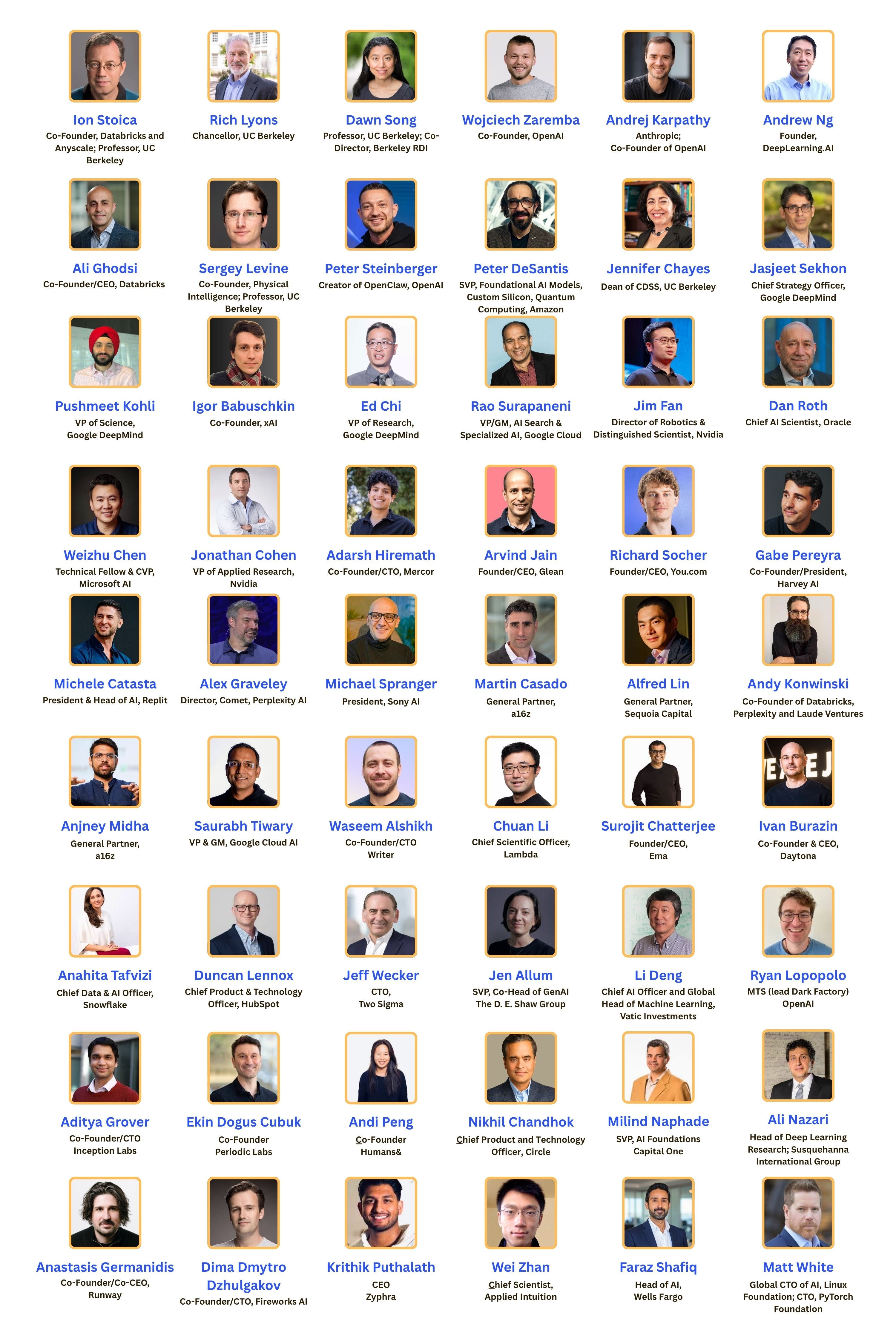
In addition, we are excited to showcase our expanded list of speakers for the Summit! We are honored to have such a great group of academics, founders, executives, and investors participate in this year’s event, and more will be announced soon!
Join Us Virtually
Can't attend the Summit in person? Join us virtually—register for the livestream to access all sessions from anywhere in the world.
You can also learn more about the Summit, the full agenda, and our event sponsors by reading Professor Dawn Song’s recent LinkedIn and Twitter/X updates:

Trends This Week
After a limited preview, OpenAI publicly launched the GPT-5.6 family, consisting of Sol, its flagship model; Terra, a lower-cost model for everyday work; and Luna, its fastest and most affordable option. OpenAI says GPT-5.6 delivers stronger performance with fewer tokens across coding, professional knowledge work, computer use, cybersecurity, scientific research, and design, with Sol setting new company-reported results on benchmarks including BrowseComp, OSWorld 2.0, Terminal-Bench 2.1, and SEC-Bench Pro. The release also introduces a new “ultra” capability setting that coordinates four agents across parallel workstreams, as well as Programmatic Tool Calling, which allows models to write and run lightweight programs that coordinate tools, filter intermediate data, and adapt their workflows with fewer model round trips. The models are now rolling out across ChatGPT, Codex, and the OpenAI API, with API pricing beginning at $1 per million input tokens and $6 per million output tokens for Luna.
This past week, Meta introduced Muse Spark 1.1, a multimodal reasoning model from Meta Superintelligence Labs designed for agentic tasks, including computer use, coding, tool orchestration, and multimodal understanding. The model can coordinate parallel subagents, manage a one-million-token context window, navigate unfamiliar interfaces, and combine scripting with direct computer interaction to complete complex, multi-application workflows. Meta also launched the Meta Model API in public preview, giving developers access to Muse Spark 1.1 through an OpenAI-compatible interface, while making the model available in “Thinking” mode through Meta AI.
This past week, Anthropic introduced Reflect with Claude, a beta dashboard designed to help users understand how they use Claude, improve their AI skills, and decide whether that usage aligns with their goals. The feature summarizes activity across the past one, three, six, or 12 months, including common topics, task types, peak usage periods, and total chats, while offering personalized recommendations based on Anthropic’s 4D AI Fluency Framework. Users can also set quiet hours and break reminders and receive prompts encouraging them to consider which tasks they want to continue doing themselves. Anthropic says Reflect is intended to make users more effective and efficient so they can accomplish their goals, preserve their original thinking, and potentially spend less time relying on Claude.
This past week, OpenAI introduced GPT-Live, a new generation of voice models designed for more natural, continuous conversations with AI. Built on a full-duplex architecture, GPT-Live can listen and speak simultaneously, respond to interruptions, wait through pauses, filter background noise, and support rapid back-and-forth or live translation. For tasks requiring web search or deeper reasoning, it can delegate work to GPT-5.5 while continuing the conversation. GPT-Live-1 is rolling out as the default ChatGPT Voice model for Go, Plus, and Pro users, while GPT-Live-1 mini will power Voice for Free users, with API access planned for a later release.
Don’t miss the developments shaping Agentic AI. Subscribe for weekly coverage of groundbreaking research, emerging trends, and critical insights across Agentic AI and the broader AI landscape.
