

Agentic AI Weekly | Berkeley RDI | July 22, 2026
Agentic AI Summit Agenda Now Live and Tickets are Running Out + Livestream Sign-Up


Agentic AI Summit 2026: Tickets are Running Out, Join Us Live for Free!
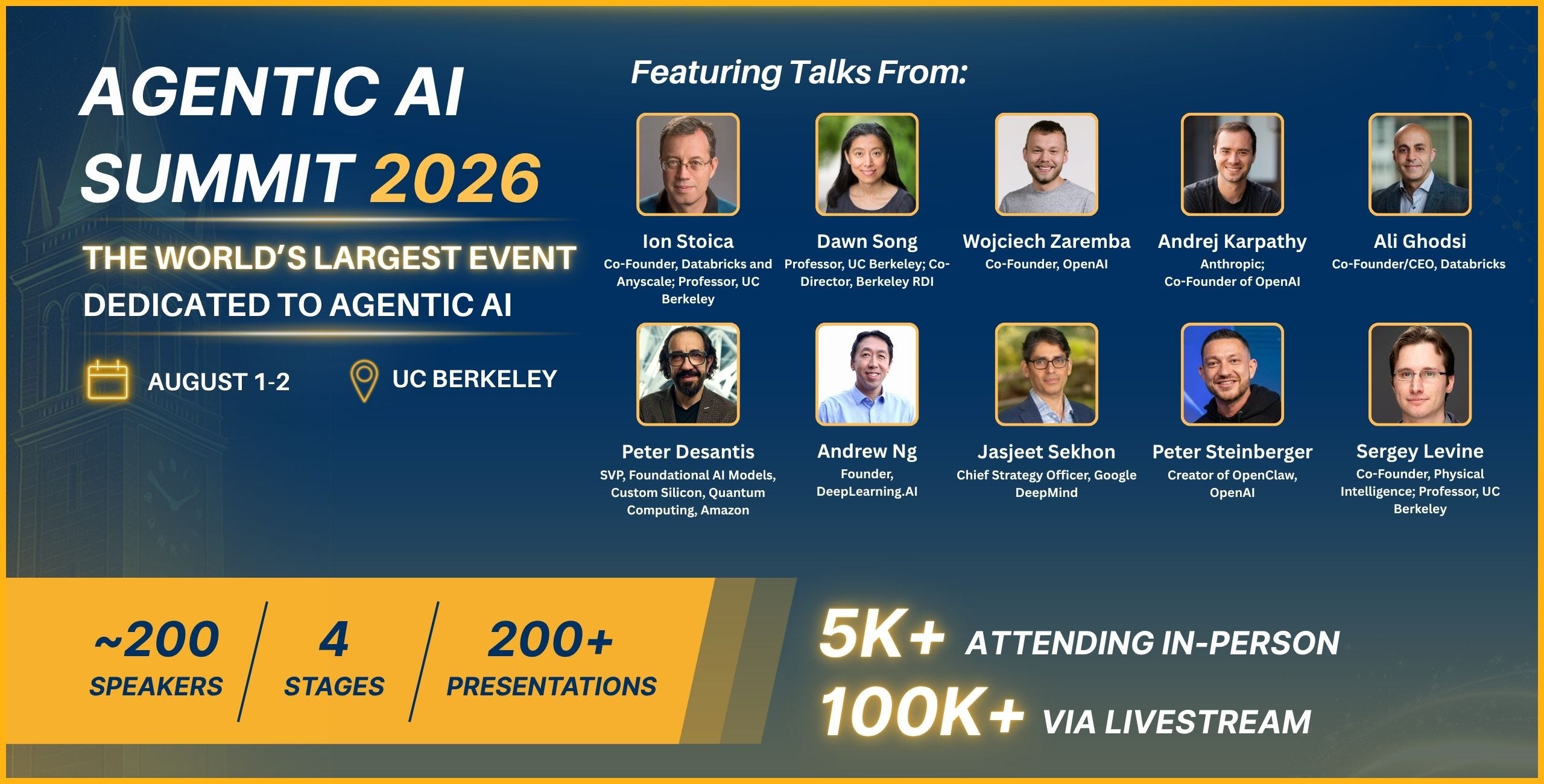
Save the date! The Agentic AI Summit returns to Berkeley on August 1–2, 2026, welcoming 5,000+ expected in-person attendees for two days of insights and innovation. Building on last year’s sold-out success—with 2,000+ in‑person attendees and 40,000+ global livestream participants—the summit will bring together researchers, builders, industry leaders, and the global agentic AI community for keynotes, technical talks and panels, hands-on workshops, live demos, and more!
Join Us Virtually
Can’t attend the Summit in person? Join us virtually—register for the free livestream to access all sessions from anywhere in the world!
🎟️ Standard Tickets (Limited Capacity)
Tickets are almost sold out, so now is the time to book your spot!
Standard: $499
Full Summit Agenda Now Available!
We are thrilled to announce that the full agenda for the Summit is now available on our website! The Summit is set to feature 200+ speakers across 4 stages, plus 200+ poster presentations during the event! If you’ve been waiting for the schedule to come out before grabbing your tickets, now is the time to take a look and secure your spot!
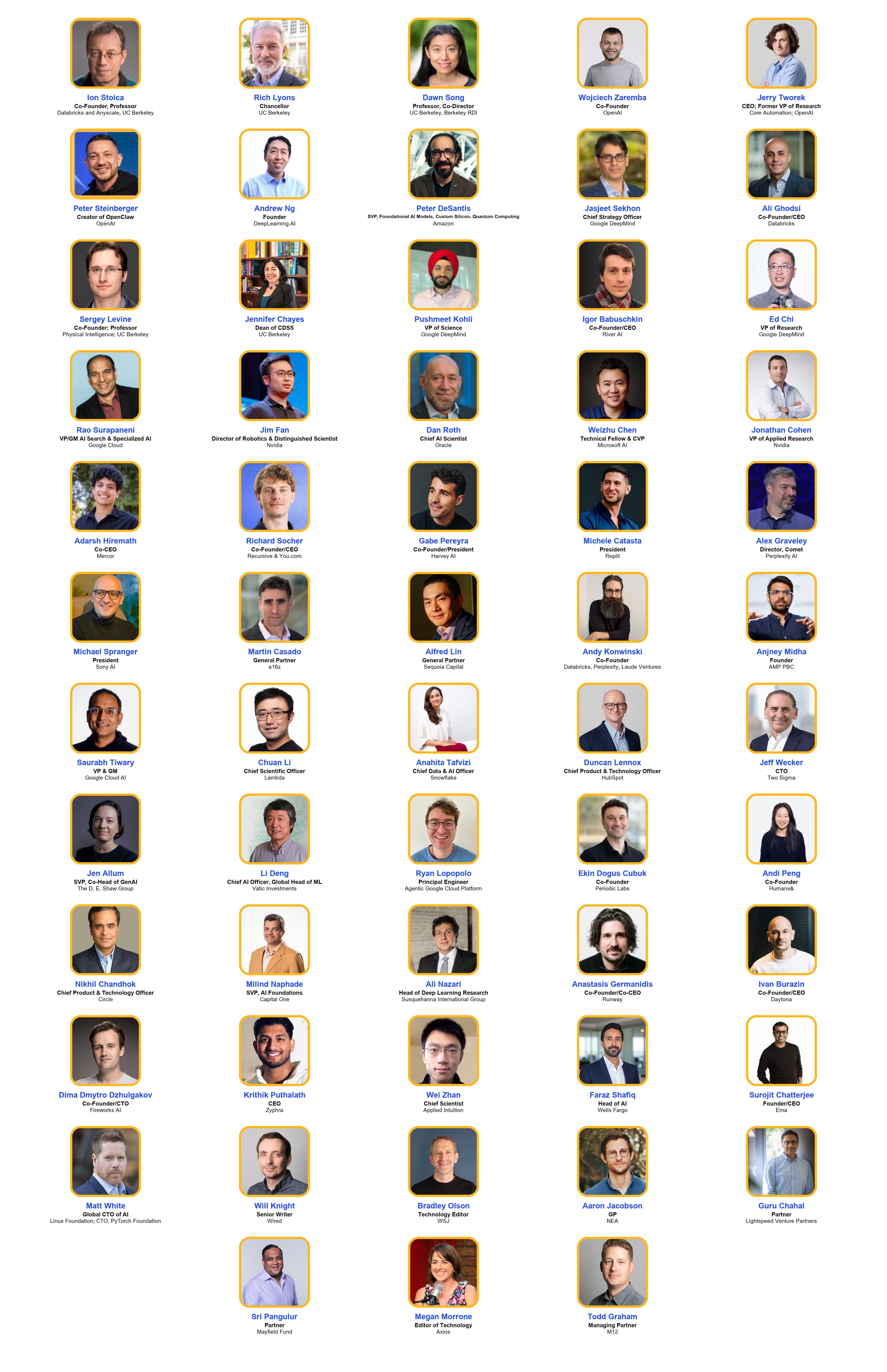
In addition, we are excited to showcase our expanded list of speakers for the Summit! We are honored to have such a great group of academics, founders, executives, and investors participate in this year’s event, and more will be announced soon!
We also want to say thanks to our amazing sponsors for their participation and for helping contribute to the Summit’s success!
You can also learn more about the Summit, the full agenda, and our event sponsors by reading Professor Dawn Song’s recent LinkedIn and Twitter/X updates:

Trends This Week
Moonshot AI released Kimi K3, its most capable model to date and the first model to reach the 2.8-trillion-parameter scale. Kimi K3 is a sparse Mixture-of-Experts model with native vision, a context window of up to one million tokens, and architectural advances including Kimi Delta Attention and Attention Residuals, which Moonshot says improve scaling efficiency over Kimi K2. Specifically, the model is designed for long-horizon coding, knowledge work, reasoning, and agentic tasks. It performed particularly strongly on agentic knowledge work and software automation, surpassing GPT-5.5 and Claude Opus 4.8 on some evaluations. Kimi K3 is currently available through Kimi’s products and API, with Moonshot planning to release its model weights on July 27, which would make it the largest open-weight model released to date
OpenAI published new research on GPT-Red, an internal automated red-teaming model designed to identify vulnerabilities and generate adversarial training data at greater scale than human testing alone. GPT-Red is trained through self-play reinforcement learning, with the model rewarded for producing successful attacks while defender models learn to resist them across scenarios involving webpages, emails, local files, and tool outputs. OpenAI used GPT-Red to adversarially train GPT-5.6 Sol, which the company says recorded six times fewer failures on its hardest direct prompt-injection benchmark than its strongest production model from four months earlier. In a separate evaluation involving previously unseen scenarios, GPT-Red successfully attacked GPT-5.1 in 84% of cases, compared with 13% for human red-teamers. OpenAI says the approach creates a safety self-improvement cycle in which current models help uncover weaknesses and train future systems to become more robust.
Google DeepMind co-founder and CEO Demis Hassabis published a proposal for a U.S.-led standards body to evaluate frontier AI models before public release. Modeled on the Financial Industry Regulatory Authority, the industry-funded and federally overseen organization would define which models qualify as frontier-class and test them for dangerous capabilities in areas including cybersecurity, biological threats, deception, and attempts to bypass safeguards. Frontier labs would initially submit qualifying models voluntarily up to 30 days before release, with the framework potentially becoming a mandatory requirement for deployment in the U.S. once its evaluation process is established. The proposal would apply based on a model’s capabilities rather than its developer, country of origin, or whether it is open or closed, and could eventually coordinate a slowdown among frontier labs if risks became sufficiently serious. Hassabis said he hopes the body can begin operating in 2026 and told Axios that dangerous capabilities in openly available models could emerge within 18 months.
Thinking Machines Lab—the AI startup founded by former OpenAI CTO Mira Murati—released Inkling, its first open-weight foundation model, designed as a customizable base for multimodal and agentic applications. Inkling is a sparse Mixture-of-Experts transformer with 975 billion total parameters, 41 billion active parameters, a context window of up to one million tokens, and pretraining across 45 trillion tokens of text, images, audio, and video. The model accepts text, image, and audio inputs and features adjustable reasoning effort across coding, tool use, forecasting, visual analysis, and audio understanding. Inkling is competitive with frontier models on selected forecasting and agentic evaluations and debuted as the highest-scoring U.S.-developed open-weights model on the Artificial Analysis Intelligence Index. Its weights are available on Hugging Face under the Apache 2.0 license, and fine-tuning is supported via Thinking Machines’ Tinker platform.

Don’t miss the developments shaping Agentic AI. Subscribe for weekly coverage of groundbreaking research, emerging trends, and critical insights across Agentic AI and the broader AI landscape.
