

Agentic AI Weekly | Berkeley RDI | July 29, 2026
Free Agentic AI Summit Livestream + Full Summit Agenda Now Live | Research Highlight: When Coding Stops Being the Bottleneck


Research Highlight: When Coding Stops Being the Bottleneck
AI will not merely accelerate software engineering. It may reorganize what software is, how it is produced, and where human judgment remains essential.
From Coding Assistance to Software Autonomy
Software engineering has always been organized around a scarce resource: people who can write, understand, and review code. Programming languages, abstractions, testing practices, and engineering organizations were all designed to help limited human teams translate requirements into reliable systems. As coding agents become capable of reasoning across repositories, implementing features, running tests, finding vulnerabilities, and coordinating longer workflows, implementation itself is beginning to become abundant.
That does not mean autonomous software development has already arrived. Current agents can perform impressive isolated tasks but often struggle to preserve correctness and architectural coherence across repeated changes. The central question is therefore no longer simply how AI can help programmers code faster. It is how responsibility can safely move from humans to AI across the software-development lifecycle.
Three Levels—and One Unifying Risk
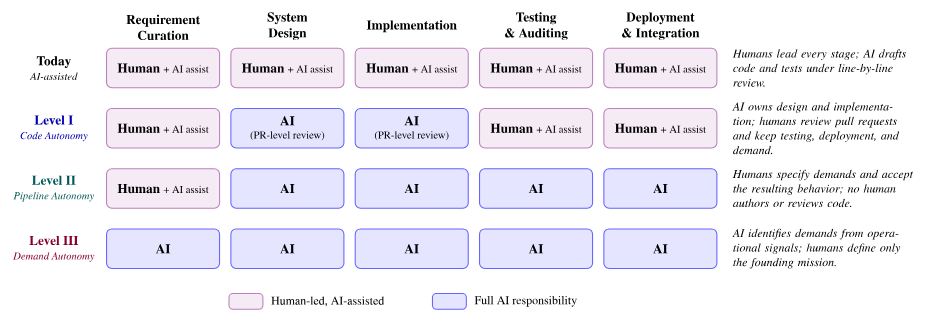
The article defines three levels of autonomy. At Level I, code autonomy, AI owns design and implementation, while humans choose the task, review the pull request, supervise testing, and approve deployment. At Level II, pipeline autonomy, AI also tests, audits, and deploys the system; humans specify the desired outcome and evaluate its behavior without reviewing the code. At Level III, demand autonomy, AI additionally identifies what should be built by interpreting telemetry, user behavior, security advisories, and the evolving state of the product.
Across all three levels, the unifying challenge is preserving human intent as direct oversight recedes. An implementation and its tests may agree with each other while both misunderstand the original requirement. The most immediate danger is therefore level-skipping: teams may claim that humans remain responsible for review while routinely approving agent-generated changes that nobody has meaningfully inspected. Higher autonomy should require stronger verification, governance, provenance, and accountability—not simply greater confidence in model capabilities.
Six Structural Shifts
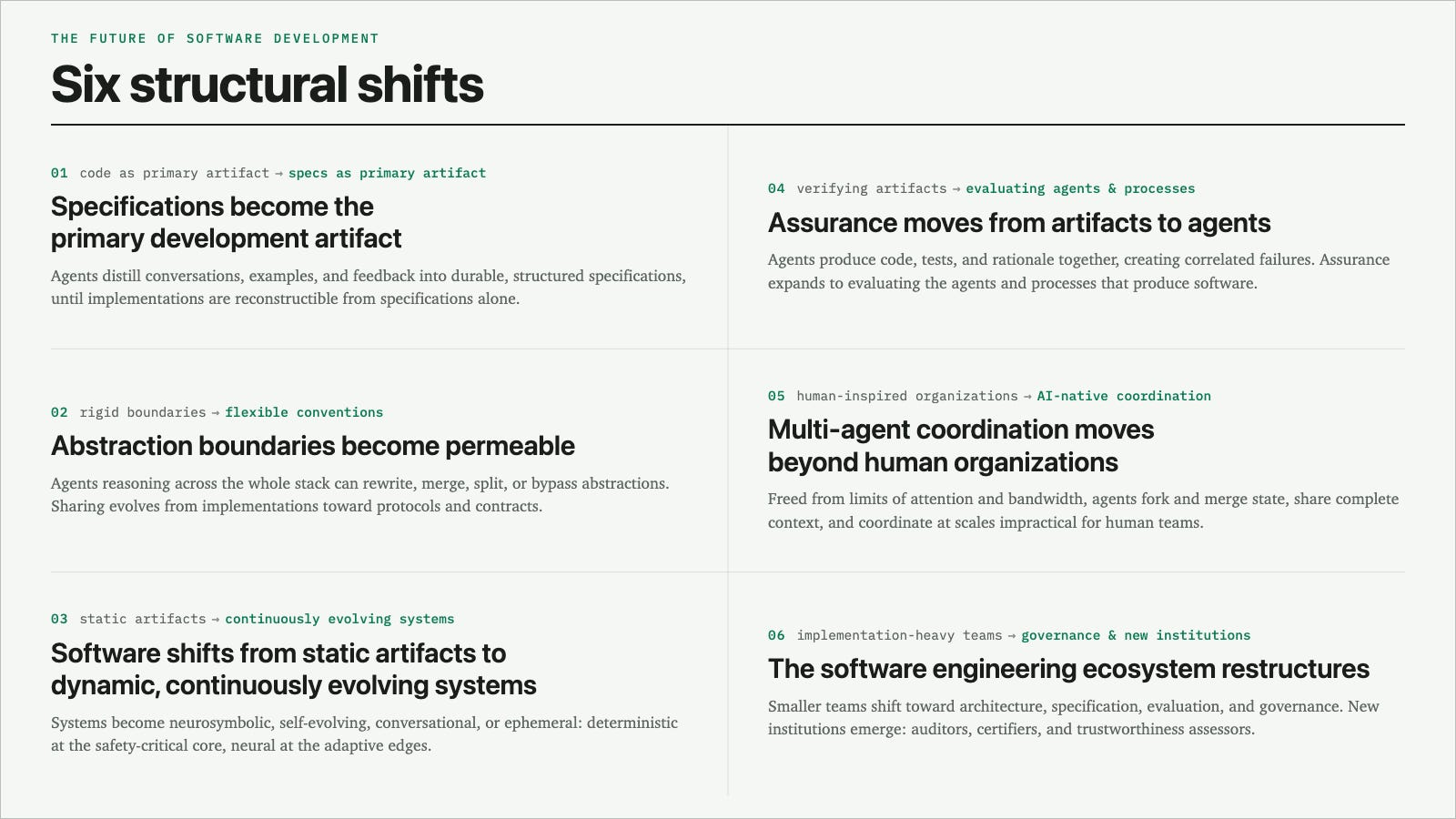
The article identifies six structural changes that follow when implementation is no longer the main constraint. These changes occur at three levels: the software artifact, the engineering process, and the broader software ecosystem. Together, they suggest that autonomous development will not produce a faster version of today’s workflow; it will produce a different workflow organized around intent, verification, and trust.
Ten Predictions for the Coming Decade
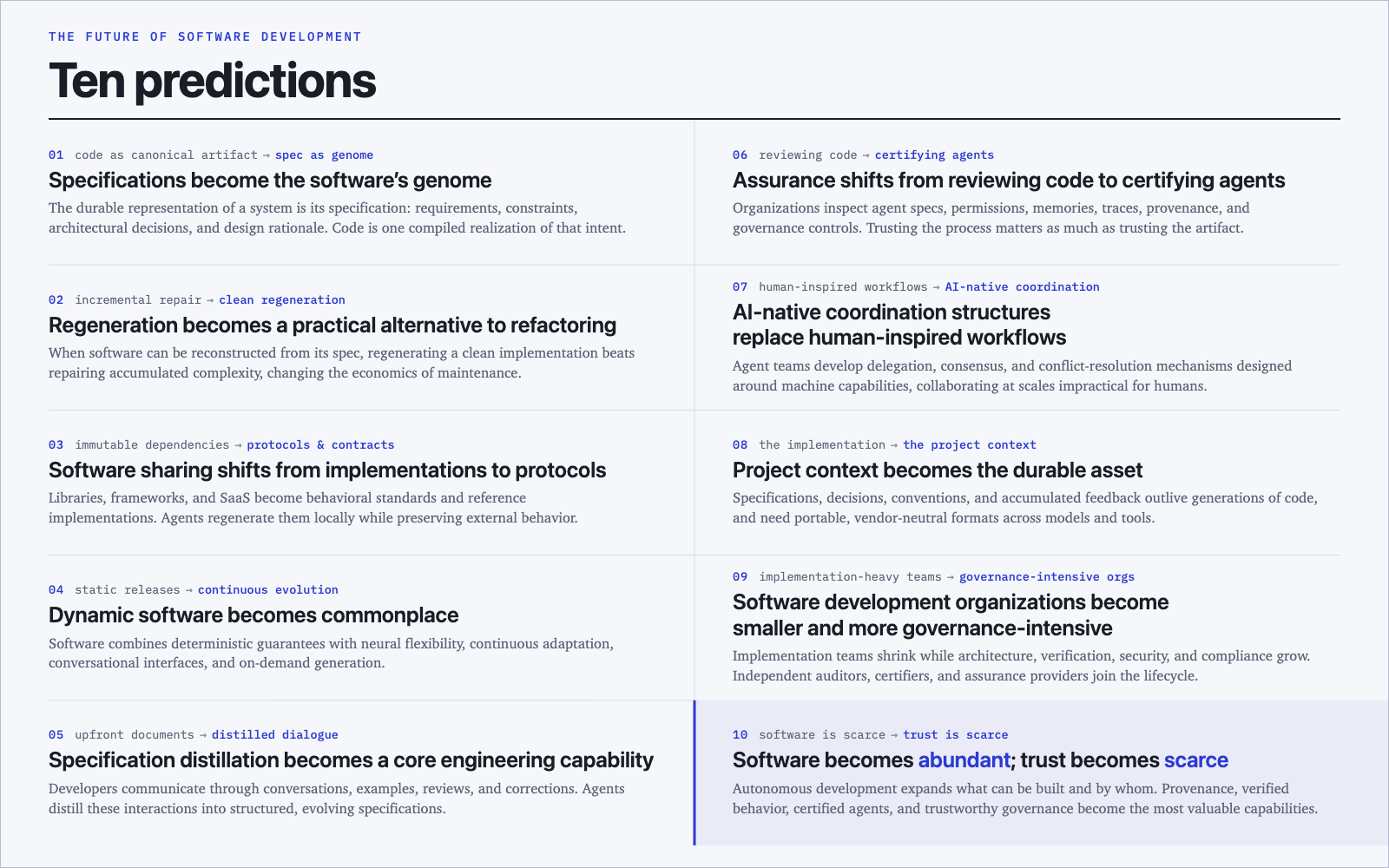
From these structural changes, the authors derive ten predictions. 1. Specifications become the long-lived “genome” of software, while code becomes a replaceable realization. 2. Regeneration becomes a practical alternative to refactoring, especially when specifications are complete. 3. Software sharing moves from implementations toward protocols and behavioral contracts. 4. Dynamic software becomes commonplace, with systems continuously adapting while preserving stable external behavior. 5. Specification distillation becomes a core engineering capability, as agents turn conversations, examples, reviews, and corrections into structured project knowledge.
The other five predictions focus on practice and organization. 6. Assurance increasingly involves certifying agents, not only reviewing their code. 7. AI-native coordination replaces workflows inherited from human organizations. 8. Project context becomes the durable organizational asset, outliving individual codebases, models, and development tools. 9. Software teams become smaller but more governance-intensive, with verification, security, compliance, and architecture growing in importance. 10. Software becomes abundant while trust becomes scarce: as producing custom software gets cheaper, provenance, behavioral verification, agent certification, and accountable governance become the most valuable parts of the ecosystem. The future of software engineering is therefore unlikely to be defined simply by fewer developers, but by a major shift in what human developers are responsible for.
Learn more about the upcoming Agentic AI Summit panel on this topic by viewing Professor Dawn Song’s X and LinkedIn posts:
In addition, you can read the original blog and paper below:

Agentic AI Summit 2026: The World’s Largest Event Dedicated to Agentic AI, Livestreamed for Free! | August 1-2 @ UC Berkeley
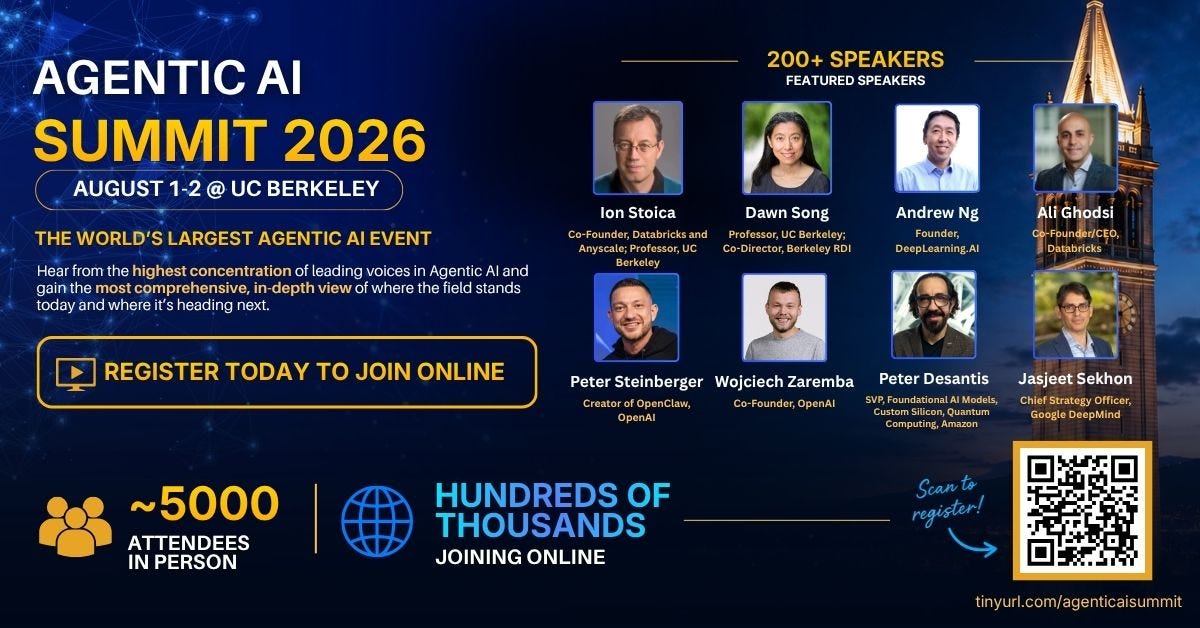
Save the date! The Agentic AI Summit returns to Berkeley on August 1–2, 2026, welcoming ~5,000 expected in-person attendees for two days of insights and innovation. Building on last year’s sold-out success—with 2,000+ in‑person attendees and 40,000+ global livestream participants—the summit will bring together researchers, builders, industry leaders, and the global agentic AI community for keynotes, technical talks and panels, hands-on workshops, live demos, and more!
The Summit is just a few days away! Though in-person tickets are sold out, you can still register for the free livestream to access all sessions from anywhere in the world! Livestream registration is closing very soon, so now is the time to book your spot!
Full Summit Agenda Now Available!
We are happy to announce that the full agenda for the Summit is available on our website! The Summit is set to feature 200+ speakers across 4 stages, plus 200+ poster presentations during the event! If you’ve been waiting for the schedule to come out before registering for the event, now is the time to take a look!
In addition, we are excited to showcase our expanded list of speakers for the Summit! We are honored to have such a great group of academics, founders, executives, and investors participate in this year’s event:
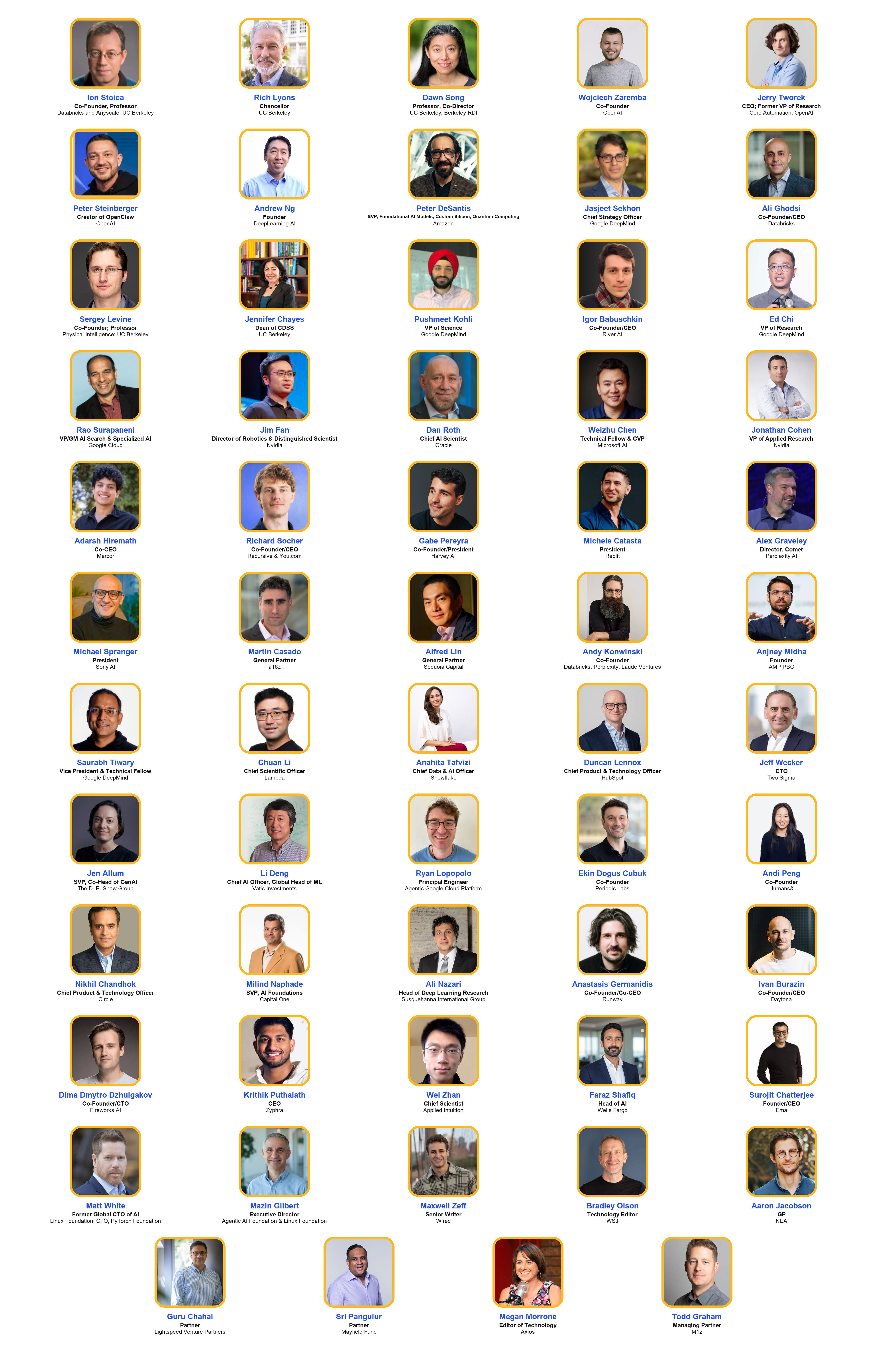
To learn more and spread the word about the Summit’s upcoming panels and discussions, you can view Professor Dawn Song’s X and LinkedIn posts!
We also want to say thanks to our amazing sponsors for their participation and for helping contribute to the Summit’s success!
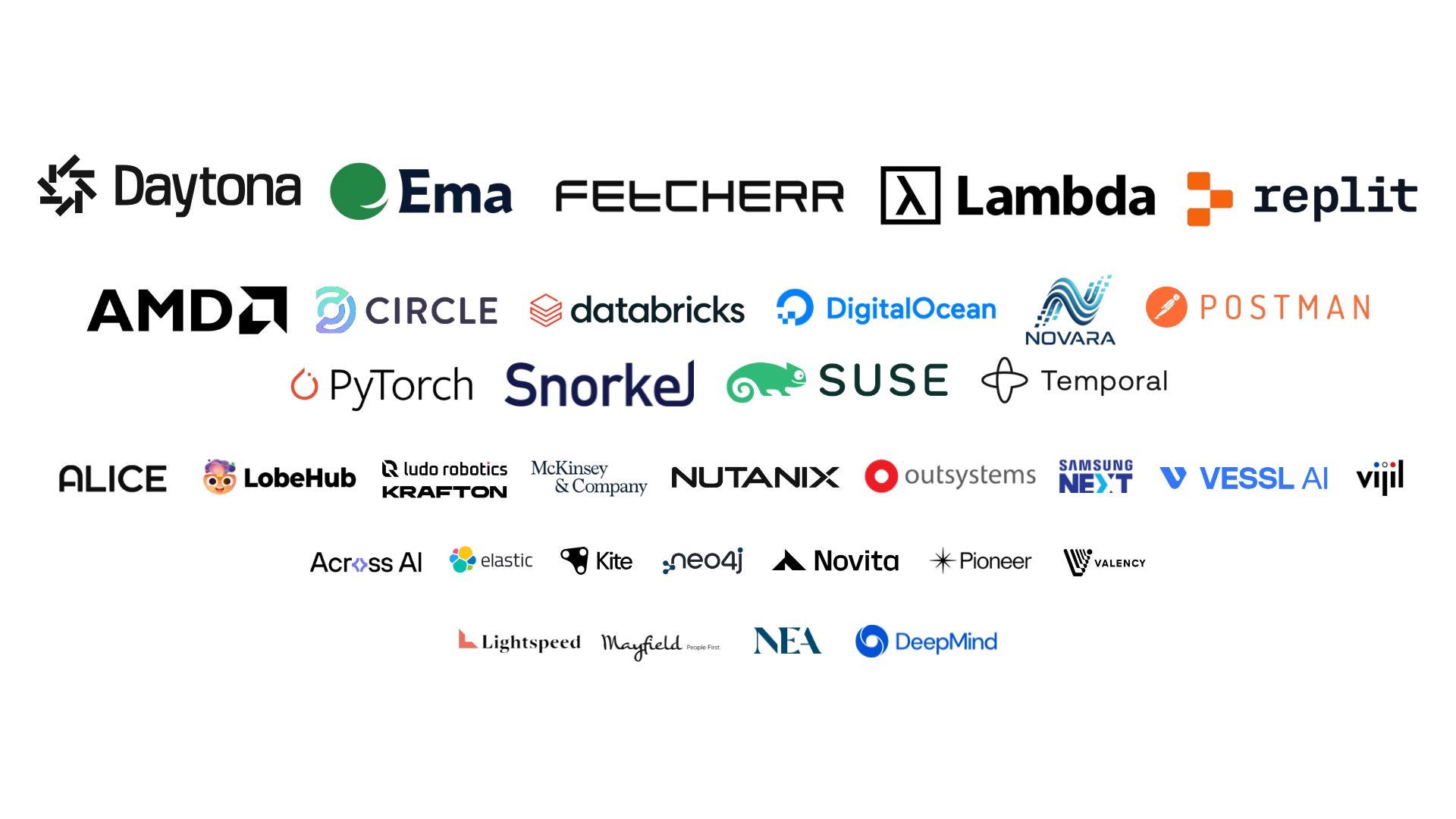
You can also learn more about the Summit, the full agenda, and our event sponsors by reading Professor Dawn Song’s recent LinkedIn and Twitter/X updates:

Trends This Week
This past week, Anthropic released Claude Opus 5, a new model positioned as a more efficient alternative to Claude Fable 5 while approaching its performance on many frontier tasks. Opus 5 is designed for coding, knowledge work, computer use, and scientific research, with adjustable effort settings that let users trade off intelligence, speed, and cost. The model reached state-of-the-art results on evaluations including Frontier-Bench and GDPval-AA, while Anthropic says it also outperformed competing models on ARC-AGI 3, AutomationBench, and OSWorld 2.0 at comparable or lower cost. Opus 5 also showed gains over Opus 4.8 across Anthropic’s life sciences benchmarks and demonstrated a stronger ability to verify its work, build testing tools, and continue iterating on difficult tasks. Anthropic describes Opus 5 as its most aligned model to date, though it remains behind Mythos 5 on offensive cybersecurity and some advanced biology capabilities. The company has made Opus 5 immediately available across its products and API, priced at $5 per million input tokens and $25 per million output tokens.
This week, Nvidia launched the Open Secure AI Alliance, an industry coalition focused on developing and sharing open tools for AI safety, cybersecurity, and agent oversight. Founding members of the alliance include Databricks, CrowdStrike, Dell Technologies, Hugging Face, Microsoft, IBM, Cisco, Palantir, the Linux Foundation, and other technology companies. Specifically, the group plans to support open models, datasets, evaluation frameworks, red-teaming tools, and agent-control infrastructure that organizations can inspect and adapt for defensive use. Nvidia is contributing model weights, data, agent-harness research, and its new open-source Object-Oriented Agent framework, which is designed to make agent actions easier to test, track, review, and govern. In announcing the alliance, Nvidia wrote that broad restrictions on open frontier models could weaken cybersecurity defenses while concentrating power and dependence among a small number of closed providers, potentially limiting transparency, collaboration, and shared progress on AI security.
Google recently introduced Gemini 3.6 Flash, Gemini 3.5 Flash-Lite, and Gemini 3.5 Flash Cyber, a new set of models focused on making agentic systems faster, more efficient, and less expensive to operate at scale. Gemini 3.6 Flash improves on 3.5 Flash across coding, knowledge work, multimodal reasoning, and computer use while using 17% fewer output tokens on the Artificial Analysis Index and requiring fewer reasoning steps and tool calls for multi-step workflows. Gemini 3.5 Flash-Lite is the fastest and lowest-cost model in the 3.5 family, reaching 350 output tokens per second and outperforming earlier Flash-Lite models on coding, long-context, and real-world task execution benchmarks. Google also introduced Gemini 3.5 Flash Cyber, a specialized model for identifying and repairing software vulnerabilities through its CodeMender security agent, where multiple agents collaborate to produce a combined analysis. Gemini 3.6 Flash and 3.5 Flash-Lite are now available through the Gemini API, Google AI Studio, Gemini Enterprise, and the Gemini app, while 3.5 Flash Cyber will initially be limited to governments and trusted partners because of its capabilities.
After an early preview period, OpenAI launched Health in ChatGPT, a new experience that allows U.S. users to connect medical records and Apple Health data for more personalized health-related conversations. With permission, ChatGPT can use information such as medications, lab results, recent visits, sleep, activity, and workouts to explain changes over time, prepare users for appointments, and place new questions in the context of their broader health history. OpenAI says the feature is supported by improved health reasoning in GPT-5.5 Instant and GPT-5.6 Sol, with the latter designed to handle more complex medical details, communicate uncertainty, and recognize when professional care may be needed.
Don’t miss the developments shaping Agentic AI. Subscribe for weekly coverage of groundbreaking research, emerging trends, and critical insights across Agentic AI and the broader AI landscape.

This shift from coding to specification and verification will reshape career trajectories for many of my clients—Indian software engineers.
I keep seeing clients treat their coding skill as a permanent asset. That's risky now.
Those who build complementary skills in specification, verification, and domain expertise are better positioned for income stability and retirement.