

Agentic AI Weekly | Berkeley RDI | June 10, 2026
Agentic AI Summit Early Bird Tickets and Expanded Speaker List


Agentic AI Summit 2026 (More Featured Speakers Announced, Early-Bird Pricing Ending Soon, and Limited Number of Tickets Left!)
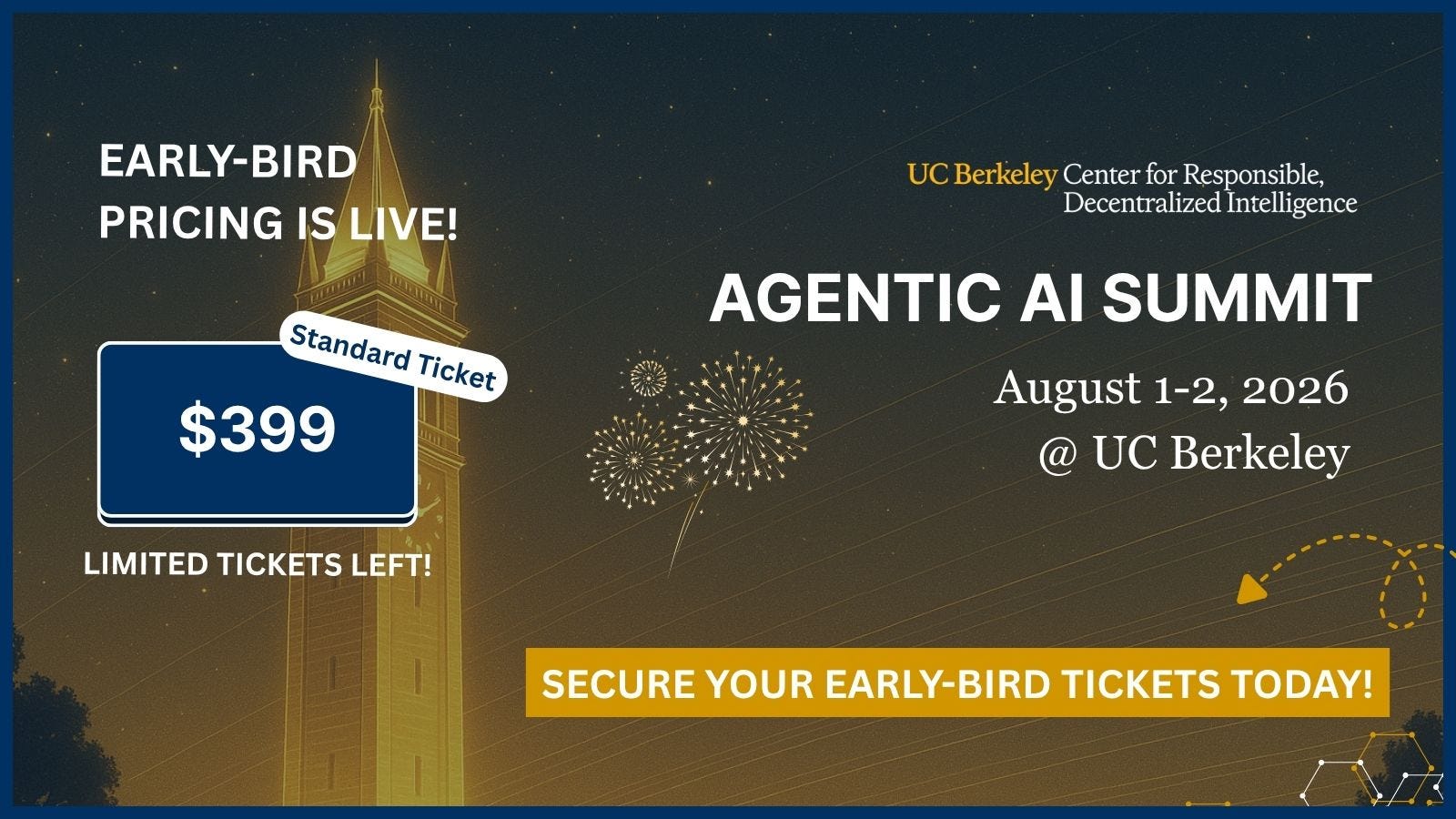
Save the date! The Agentic AI Summit returns to Berkeley on August 1–2, 2026, welcoming 5,000+ expected in-person attendees for two days of insights and innovation. Building on last year’s sold-out success—with 2,000+ in‑person attendees and 40,000+ global livestream participants—the summit will bring together researchers, builders, industry leaders, and the global agentic AI community for keynotes, technical talks and panels, hands-on workshops, live demos, and more!
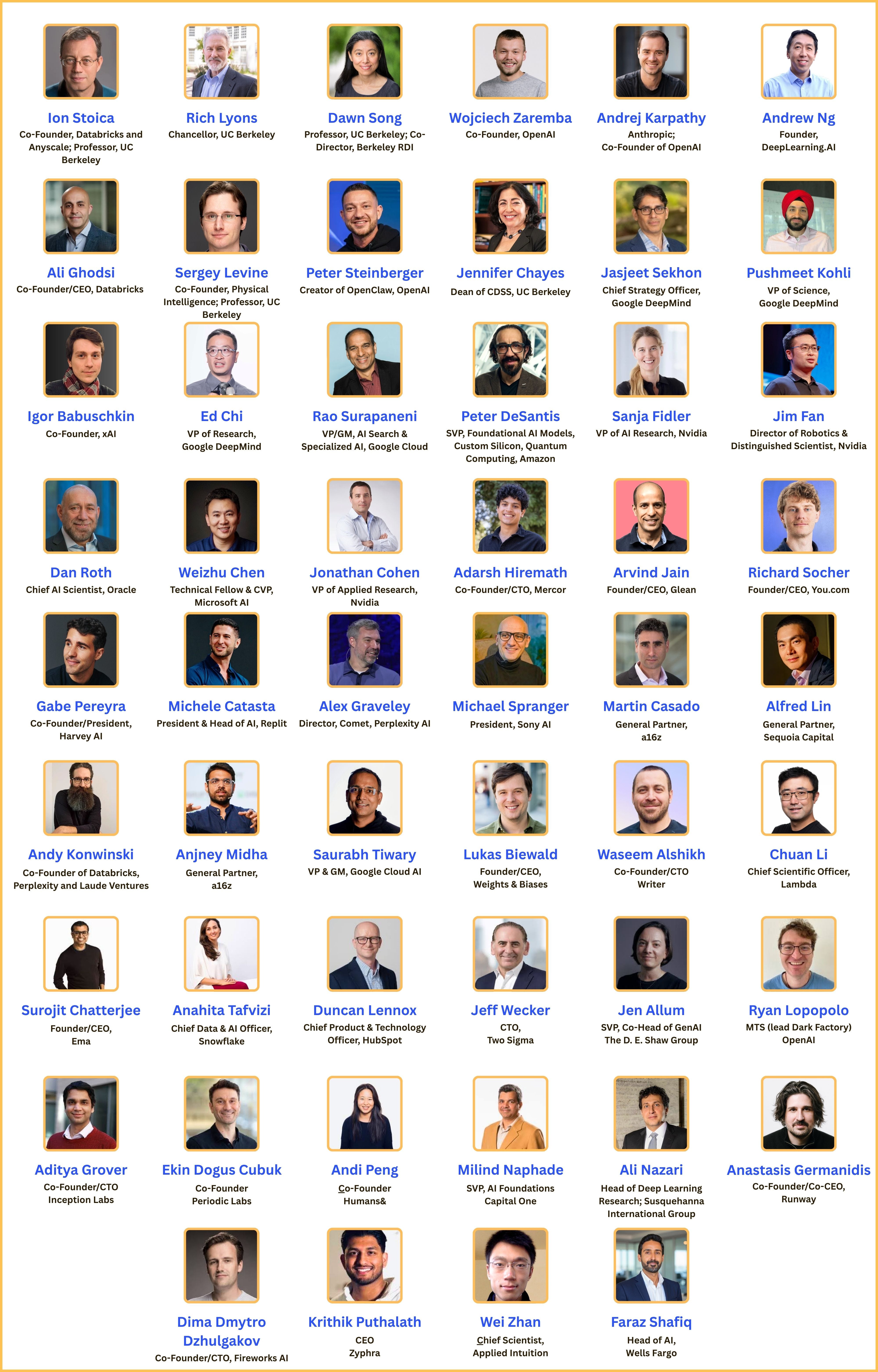
In addition, we are excited to showcase our expanded list of speakers for the Summit! We are honored to have such a great group of academics, founders, executives, and investors participate in this year’s event, and more will be announced soon!
🎟️ Early‑Bird Pricing (Limited Capacity)
A limited number of early‑bird tickets are still available:
Standard Early-Bird: $399
Sponsorship Opportunities
Partner with us to shape the future of Agentic AI. If you’re interested in sponsoring the summit, please complete the sponsorship application form. Sponsorship opportunities are limited and reviewed/allocated on a rolling basis, so we encourage you to apply early.

AgentX–AgentBeats Winners Announcement: Thank You to Everyone Who Participated!
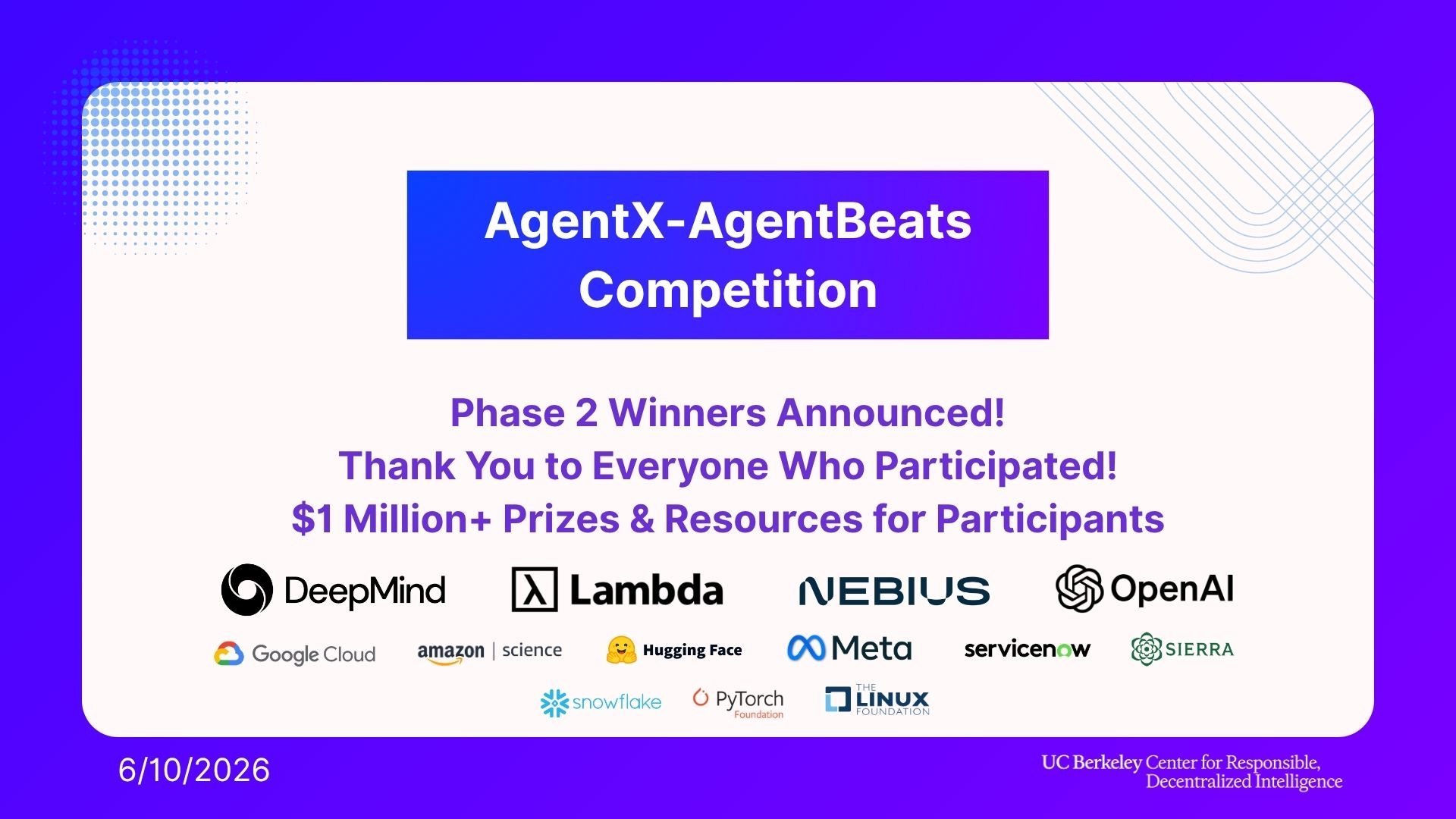
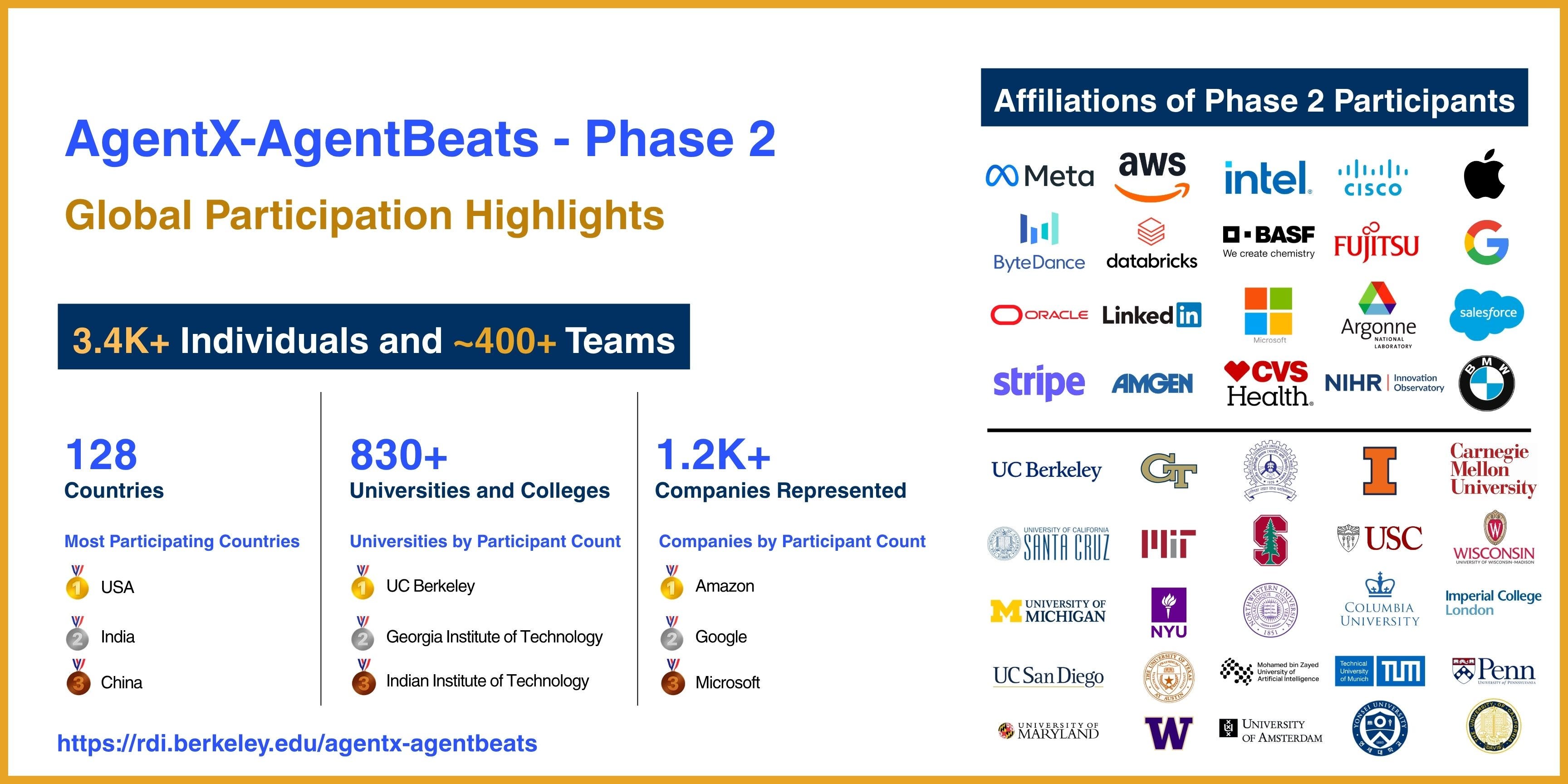
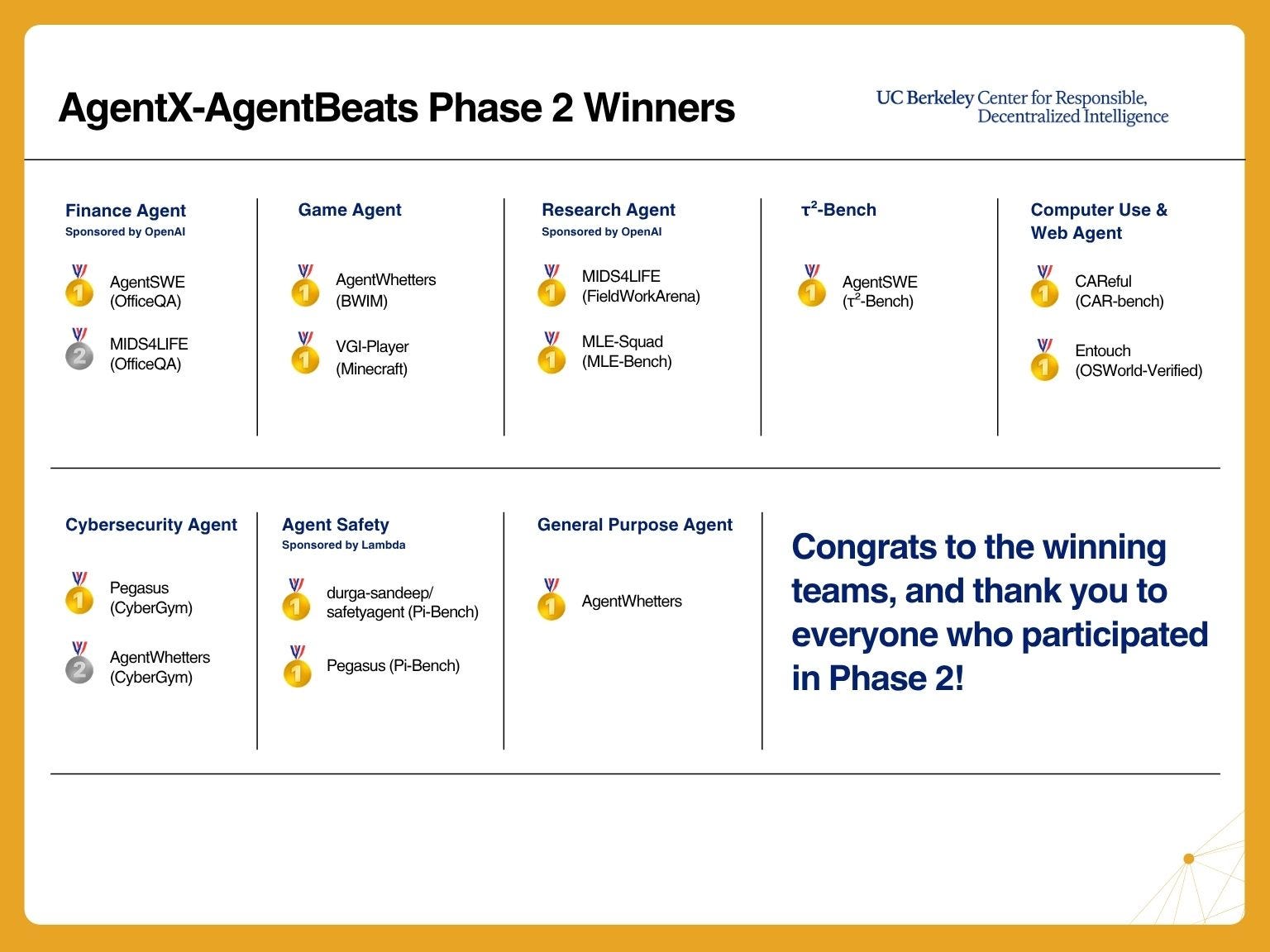
Thank you to everyone who participated in Phase 2 of the AgentX–AgentBeats Competition! Thanks to all of you, the competition was a massive success. Over 3,400 individuals participated in Phase 2 from around the world, and over 2,000 universities, colleges, and companies were represented!
Congratulations to all of the Phase 2 winning teams:

Trends This Week
Anthropic announced Claude Fable 5, a new Mythos-class model that the company describes as its most capable generally available AI system to date. According to Anthropic, Fable 5 achieves state-of-the-art performance across software engineering, knowledge work, vision, scientific research, and long-context tasks, with its advantages becoming more pronounced on longer and more complex workflows. The company highlighted examples from early users, including a codebase-wide migration that reportedly compressed months of engineering work into a single day and strong performance on finance, research, and analytical reasoning benchmarks. Alongside Fable 5, Anthropic introduced Claude Mythos 5, a version of the same underlying model with fewer restrictions that is initially available only to trusted cybersecurity and infrastructure partners. Because of the model's advanced cyber and scientific capabilities, Anthropic also launched a new safeguard system that automatically routes certain biology, chemistry, cybersecurity, and model-distillation requests to Claude Opus 4.8.
Google DeepMind introduced Gemma 4 12B, a new open-weight multimodal model designed to bring advanced AI capabilities directly to consumer laptops. The model features a novel encoder-free architecture that processes text, images, and audio through a unified transformer rather than relying on separate vision and audio encoders, reducing memory requirements and latency. Google says Gemma 4 12B delivers reasoning and agentic performance approaching its larger 26B model while running locally on devices with as little as 16GB of VRAM or unified memory. The company also released the model under the permissive Apache 2.0 license, allowing developers and organizations to freely modify and commercialize it. In addition, Gemma 4 12B includes native audio support, Multi-Token Prediction drafters to improve inference speed, and compatibility with popular local AI tooling such as Ollama, Hugging Face Transformers, llama.cpp, and vLLM, further expanding the ecosystem for on-device and edge AI applications.
Microsoft AI unveiled a new family of in-house AI models spanning reasoning, coding, image generation, transcription, and voice. The new lineup includes MAI-Thinking-1, a flagship reasoning model that Microsoft says rivals leading models in software engineering and mathematical reasoning, alongside specialized models for coding, image generation, speech synthesis, and transcription. Beyond the models themselves, Microsoft introduced Frontier Tuning, a framework that allows organizations to adapt and optimize AI models using reinforcement learning on their own workflows. According to the company, custom-tuned MAI models have achieved performance comparable to larger frontier models while operating at significantly lower cost. Microsoft also announced a new partnership with the Mayo Clinic to develop a healthcare-focused AI model designed for advanced clinical reasoning and medical decision support. The company emphasized that the MAI family was built entirely in-house using proprietary infrastructure, licensed datasets, and Microsoft's Maia AI chips as part of the company’s push toward long-term AI self-sufficiency.
This past week, Anthropic published a new report examining the possibility of recursive self-improvement, the idea that AI systems could eventually play a major role in developing their own successors. The report included several previously undisclosed metrics from inside Anthropic, including that Claude now authors more than 80% of the code merged into the company’s production codebase and that the average engineer is shipping roughly eight times more code than in 2024. Anthropic also reported that Claude’s success rate on its most open-ended coding tasks has climbed to 76%, while internal research found that Claude Mythos Preview was able to accelerate certain model-training optimization tasks by approximately 52× compared to baseline approaches. While Anthropic emphasized that humans remain responsible for setting research direction and exercising judgment, the company argues that AI is already accelerating its own development.
OpenAI rolled out a major upgrade to ChatGPT's memory system, introducing a new architecture designed to improve personalization, long-term context retention, and user transparency. The update builds on an internal process called "dreaming," which allows ChatGPT to synthesize information across conversations and automatically maintain a more coherent understanding of a user's preferences, interests, and goals over time. As part of the release, users can now view and edit a generated memory summary, see which memories were used to personalize a response, and control how ChatGPT references that information. OpenAI says the new system is better at carrying context across conversations, adapting to evolving preferences, and updating outdated information automatically. The rollout is beginning with Plus and Pro users in the United States, while upcoming efficiency improvements will also enable memory capabilities for free users in the future.
Don’t miss the developments shaping Agentic AI. Subscribe for weekly coverage of groundbreaking research, emerging trends, and critical insights across Agentic AI and the broader AI landscape.
